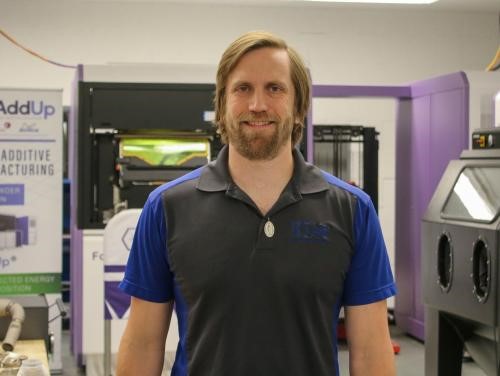
Director of Additive Manufacturing The Ohio State University
Laser beam shaping has the potential to unlock the production of high γ’ nickel superalloys through Laser Powder Bed Fusion (LPBF). These alloys are considered difficult to weld due to crack formation during the manufacturing process. By integrating beam shaping into temporal and spatial multi-scale models, the solidification heterogeneity of γ’ nickel superalloys can be evaluated. Specifically, temporal solidification models combining phase calculations, element modeling, and computation fluid dynamics (CALPHAD, FEM/FEA, and CFD respectively) that incorporate chemistry and stress are employed to elucidate alloy segregation and restraint. Spatial modeling of the melt pool will provide initial stress and strain values that will predict suitable parameters for LPBF fabrication of test samples. Multiple beam shapes and laser combinations will be evaluated with an iterative temporal, spatial, and fabrication methodology. By incorporating beam shaping into experimental validation studies to evaluate solidification cracking under different thermal conditions, this research provides a novel and more holistic understanding of solidification modes for LPBF γ’ nickel superalloys. Improvements of crack reduction and component density are enabled, furthering the knowledge needed to overcome critical hurdles from crack formation due to microstructural and chemical heterogeneities. Once cracking has been minimized, γ’ nickel superalloys with over 5 wt.% Al+Ti will gain AM industry adoption. This research explores multiple γ’ nickel superalloys with superalloy 939 as a focus for printing due to the alloy’s desired mechanical properties and solidification cracking susceptibility.
Learning Objectives:
Upon completion, participants will be able to understand crack mechanisms for printing high gamma prime nickel superalloys
Upon completion, participants will be able to implement beam shaping technologies for material development