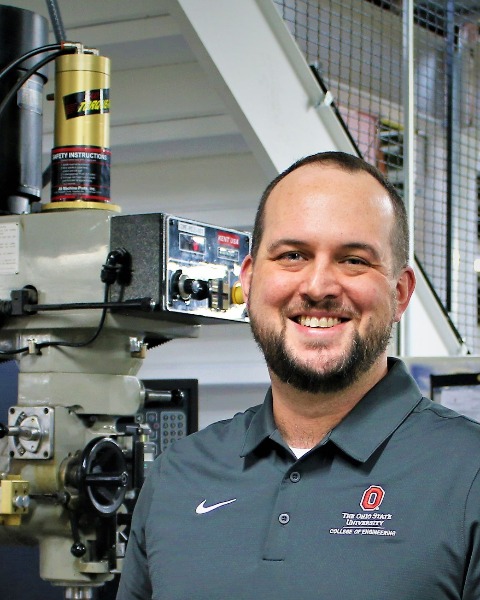
Principal Engineer Ohio State University - Center for Design and Manufacturing Excellence
This project investigates the dimensional accuracy, recyclability, and forming performance of medium-format 3D-printed polymer stamping dies produced from recycled, glass-fiber-reinforced thermoplastic. The work aims to establish the limits of unmachined additive tooling and define pathways for circular use of materials in metal forming applications. Dimensional capability was evaluated using small feature forming tools printed by pellet-fed, or Fused Granulate Fabrication (FGF), using a 3mm diameter nozzle and 1.5mm layer height. Tooling was tested using 1mm thick, 270 MPa, automotive sheet steel. Parts and tools were 3D scanned throughout progressive forming cycles to monitor geometric deviation, wear behavior, and feature degradation. Tool life was defined by loss of shape control and increasing springback error, providing an experimental basis for tolerance prediction in future designs.
Material recovery was studied using printed polymer dies as well as shells backfilled with low-melting tin alloys. After forming trials, the backfill material is removed by thermal and mechanical means, and the polymer is recovered by granulation and pelletizing. Results informed the financial, resource, and energy efficiencies available to support re-use in subsequent print cycles.
Functional validation was demonstrated through forming trials with 3D printed stamping tools for a functional sheet metal component. Comparative inspection of the inserts and formed components confirmed the limits of polymer tooling in terms of surface quality and dimensional control without secondary machining. The findings indicate that polymer tooling offers a practical, low-cost option for prototype and low-volume forming operations, if the dimensional limitations can be accepted. Energy use and material waste are reduced compared with traditional machined or cast dies, supporting broader adoption of sustainable manufacturing methods within sheet metal forming.
Learning Objectives:
Upon completion, participants will be able to evaluate the dimensional accuracy, durability, and surface performance of 3D-printed polymer tools as a viable option for prototype and low-volume sheet-metal applications.
Upon completion, participants will be able to describe how additive polymer tooling materials can be recovered, reprocessed, and reused to enable closed-loop, energy-efficient, and cost-effective circular manufacturing workflows.
Upon completion, participants will be able to interpret experimental forming and material recovery data to define process limits, lifecycle efficiency, and design criteria for future sustainable tooling implementations.